
.png)
Conducting PPC campaigns nowadays does not only entail driving traffic; it entails counting the traffic. Most companies spend on advertisements, clicks keep flowing in, converting them into real clients. Professional PPC agencies come in there.
An optimized campaign does not only bring visitors, but it assists in transforming Clicks into Customers with the help of strategic, data, and user experience. As competition levels increase, the cost of advertising also goes up, and this requires a more intelligent way of maximizing returns by businesses.
Indeed, according to the recent industry reports, businesses make an average of $2 on every 1 dollar spent on PPC. Nevertheless, this can only occur when campaigns are streamlined appropriately. Unless optimized, the ad spend may soon become a waste of funds.
This blog explores how PPC agencies refine campaigns, improve conversion rates, and help businesses achieve measurable growth.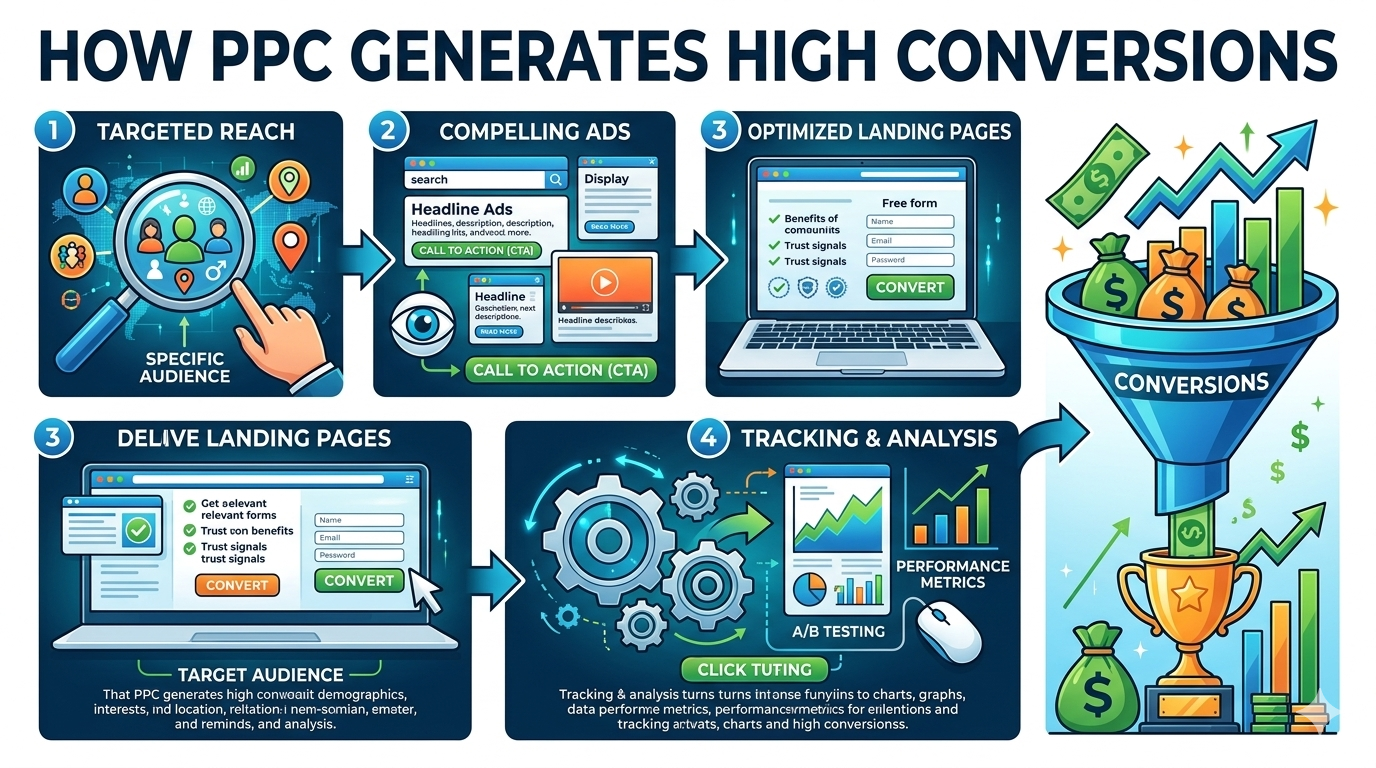
What is Conversion Rate in PPC
A conversion is any desired action, whether it’s a purchase, a form submission, or a sign-up. Conversion rate measures how many users complete that action compared to the number of clicks. For example, if 100 people click your ad and 5 convert, your conversion rate is 5%.
While many businesses focus on metrics like impressions or clicks, experienced PPC agencies know that conversions are what truly matter. High traffic without conversions doesn’t drive revenue, it only increases costs.
That’s why agencies shift the focus from vanity metrics to performance-driven KPIs like:
- Cost Per Acquisition (CPA)
- Return on Ad Spend (ROAS)
- Conversion Rate
Top Strategies to Enhance Conversion Rates
Strategic Keyword Optimization & Search Intent Alignment
One of the biggest reasons PPC campaigns fail is poor keyword targeting. Not all clicks are equal; some users are just browsing, while others are ready to buy.
Strategic Keyword Optimization and search intent alignment ensure your content reaches the right audience at the right time. By targeting relevant keywords based on user intent—informational, navigational, or transactional—you improve visibility, attract qualified traffic, and boost conversions. This approach helps create meaningful content that matches what users are actively searching for online.
- High-intent keywords (e.g., “buy,” “hire,” “best”)
- Long-tail keywords with specific intent
- Negative keywords to filter irrelevant traffic
For example, someone searching “best PPC agency for startups” is far more likely to convert than someone searching “what is PPC.”
By aligning keywords with user intent, agencies ensure that ads appear in front of users who are already interested, significantly increasing the chances of conversion.
Audience Targeting & Segmentation
- Location
- Device type
- Interests and behaviors
- Past interactions (remarketing)
Remarketing is especially powerful. Studies show that users who have previously interacted with a brand are up to 70% more likely to convert. By showing tailored ads to these audiences, agencies create more personalized experiences, which leads to higher engagement and better conversion rates.
By showing tailored ads to these audiences, agencies create more personalized experiences, which leads to higher engagement and better conversion rates.
High-Converting Ad Copy & Creative Optimization
The users have the first contact with your brand through your ad copy. Unless it catches the eye or communicates value, the user will not make a click, or even worse, the user will make a click and not convert. Creative optimization and high converting ad copy are important factors that contribute to PPC success. Direct communication, powerful headlines, and good graphics are among the features that attract attention immediately. When the advertisement makes value and resonates with the intent of the user, it will not only boost clicks but the conversion rate as well, so your marketing activity can yield valuable and quantifiable business outcomes.
PPC agencies focus on creating:
- Clear and compelling headlines
- Strong value propositions
- Action-driven CTAs (Call-to-Action)
- Emotional triggers that resonate with users
Instead of generic messaging, they highlight benefits. For example:
- “Get More Leads Fast” performs better than “Digital Marketing Services”
- “Start Your Free Trial Today” drives more action than “Learn More”
Additionally, agencies use ad extensions like callouts, sitelinks, and reviews to provide more information and build trust.
One-half of the job is to drive traffic. The actual job occurs on the opening page.
The optimization of the landing page is vital in enhancing the performance of PPC and transforming the visitors into the customers. An optimized landing page is concerned with clear messages, powerful headlines, quick load speed and an interesting call-to-action. It must be user-intended and aligned to the ad content to minimise the bounce rates. Through testing such aspects as design, copy, and layout, businesses will be able to improve user experience, boost their engagement, and provide better conversion rates of their campaigns.
Landing Pages in PPC Success play a critical role in determining whether a user converts or leaves.
PPC agencies optimize landing pages by:
- Ensuring message match between ad and page
- Improving page load speed
- Using clear and visible CTAs
- Reducing distractions and unnecessary elements
- Adding trust signals like testimonials and certifications
PPC performance can be improved with the help of A/B testing and continuous experimentation. Marketers are able to define the most effective headlines, ad copies, visuals, and landing pages by experimenting with them to determine which ones appeal most to their audience. This data-driven campaign can be used to optimize campaigns, minimize costs, and maximize conversions. By keeping on experimenting, you will keep your strategy abreast with the evolving user behavior and you will make smarter decisions and will get improved results in the long run. There is no PPC campaign that works in the same manner. Agencies constantly experiment and perfect each component.
A/B testing involves comparing two versions of:
- Ad headlines
- CTAs
- Landing page layouts
- Images or creatives
By analyzing performance data, agencies identify what works best and implement changes accordingly. Even small improvements, like changing a headline or button color, can lead to noticeable increases in conversion rates over time.
Smart Bidding & Budget Optimization
Budget management is a key in the success of PPC. Smart bidding is a strategy of the agencies to get maximum results at minimum cost. Bid a little smarter and maximize your ad spend without the guesswork using smart bidding and budget optimization. Through data-driven strategies, you can automatically optimize your bids, reach high converting audiences and cut waste budgets. This translates to improved outcomes, increased ROI and more effective campaigns. You will invest wiser than spend a lot of money on ads that will not be effective and will not help your business grow bigger.
Popular bidding strategies include:
- Target CPA (Cost Per Acquisition)
- Target ROAS (Return on Ad Spend)
- Maximize Conversions
These strategies use real-time data and machine learning to adjust bids automatically, ensuring ads appear at the right time and place. Additionally, agencies allocate more budget to high-performing campaigns and pause underperforming ones, ensuring every dollar is used efficiently.
Conversion Tracking & Data-Driven Decisions
Without proper tracking, it’s impossible to measure success. Conversion tracking isn’t just data, it’s your roadmap to smarter growth. By analyzing real user actions, you can refine campaigns, reduce wasted spend, and boost ROI. If you want to create high-converting campaigns, you can hire Top PPC Agencies to turn insights into effective strategies. With data-driven decisions, you’re not guessing—you’re optimizing every click to attract the right audience and convert them into loyal customers.
PPC agencies set up advanced tracking systems to monitor:
- Conversions and revenue
- User behavior
- Drop-off points in the funnel
This data helps identify what’s working and what needs improvement. For example, if users are clicking ads but not completing forms, the issue might be with the landing page design or form length, not the ads themselves. By continuously analyzing data, agencies make informed decisions that improve performance.
Improving Quality Score for Better Results
Quality Score is a key factor in PPC campaigns, especially in platforms like Google Ads. Improving your Quality Score can make a real difference in how your ads perform. When your ads, keywords, and landing pages are closely aligned, you not only lower your costs but also attract more relevant clicks. It’s less about spending more and more about working smarter. By focusing on user intent and relevance, you can gradually improve results and get better returns from your PPC efforts.
- Ad relevance
- Expected click-through rate
- Landing page experience
A higher Quality Score leads to:
- Lower cost per click (CPC)
- Better ad placement
- Higher conversion potential
PPC agencies focus on improving Quality Score by aligning ads, keywords, and landing pages, resulting in better performance at lower costs.
Mobile Optimization & User Experience
With more than 60% of online traffic coming from mobile devices, mobile optimization is no longer optional. Mobile optimization is essential for delivering a smooth and effective user experience. A responsive and fast-loading website ensures that users can easily navigate, explore, and interact across all devices. When visitors find your site easy to use, they are more likely to stay longer and engage with your content. Focusing on mobile-friendly design helps improve overall performance and creates better opportunities for user interaction and business growth.
- Ads are mobile-friendly
- Landing pages are responsive
- Forms are easy to complete on smaller screens
Simplifying the user experience on mobile devices significantly improves conversion rates.
Leveraging AI & Automation in PPC
The PPC campaigns are being changed through AI. Use of AI and automation in PPC will entirely transform your campaigns performance. AI assists you in making smarter decisions to reach the right audience and at the right time as opposed to manually managing bids and targeting. Automation is a time-saving, error-reducing, and result-enhancing method of running ads in an optimized manner. The companies will be able to grow more quickly, convert more, and achieve higher ROI without the need to monitor these factors all the time. It is a smarter, more effective method of managing the high-performing PPC campaigns in the present day.
- Smart bidding
- Audience targeting
- Predictive analytics
These tools analyze vast amounts of data and make real-time adjustments, improving efficiency and performance. However, human expertise remains essential. Agencies combine automation with strategic thinking to achieve the best results.
Competitor Analysis & Market Insights
Knowledge of what competitors are up to can be a good source of information. Monitoring your competitors can actually make you a smarter person. You will be able to find new opportunities and enhance your approach by knowing what other people are doing and what works in your market. It also assists in you being more connected to your audience and making more decisive choices. By having the correct insight, you will be a step ahead and create a stronger presence without making your strategy overly complex.
PPC agencies analyze:
- Competitor keywords
- Ad copy strategies
- Landing page approaches
This helps identify gaps and opportunities, allowing businesses to refine their campaigns and stand out.
Continuous Campaign Monitoring & Optimization
PPC campaigns cannot work on the basis of setup only, they require monitoring and optimization. PPC agencies also constantly monitor such indicators as conversion rate, CTR, CPA, and ROAS to see how the campaigns are doing and what needs to be improved. With constant evaluation, agencies are able to spot problems in real time like increased costs, decreased conversions, or poor performing keywords. They then optimize campaigns through bid optimization, audience targeting, ad creative optimization, and keyword optimization. This will keep the ad spend at all times efficient. Scaling what works is also another key element. The campaigns that perform well receive a larger budget and those performing poorly are put on hold or rewritten. This would be useful in preserving efficiency and profitability. The constant optimization enables agencies to be flexible to the market trends, user behavior and competition. Rather than using a set strategy, campaigns get improved with time, which results in improved performances, conversions, and eventual growth of the business.