
Businesses are not merely pursuing traffic, they are pursuing a true return on investment (ROI). The decision on which marketing strategy to adopt has never been as important as it is today due to the competition, escalating advertisement expenses, and the changing search engine algorithms.
The two strongest tools that control this space are: Search Engine Optimization (SEO), and Pay-Per-Click (PPC) advertising. Each one has its own benefits, but comparing them to ROI in 2026, the question will always be which one will really have a better outcome?
It is not as simple as choosing one among them. Rather, it is in the knowledge of each strategy and how it will affect your business objectives and how it will fit into your development plan.
SEO and PPC: A Quick Overview
Let’s start with the basics.
SEO is all about improving your website’s visibility organically on search engines like Google. It involves optimizing content, technical structure, and backlinks to rank higher in search results. Over time, SEO helps businesses achieve long-term growth by consistently attracting relevant users without paying for every click.
On the other hand, PPC is a paid strategy where businesses bid on keywords and pay each time someone clicks their ad. Platforms like Google Ads allow precise targeting, making it easier to reach the right audience instantly. Because of this, many businesses depend on Pay Per Click (PPC) Companies to optimize and manage their campaigns efficiently.
While SEO builds a foundation, PPC delivers immediate visibility, making both essential in a modern marketing mix.
ROI in Digital Marketing
ROI in digital marketing isn’t only about revenue. It reflects how effectively your investment converts into measurable results such as qualified leads, higher conversions, and long-term customer retention, helping businesses evaluate performance and make smarter marketing decisions.
Key metrics that define ROI include:
- Cost Per Acquisition (CPA)
- Conversion Rate
- Customer Lifetime Value (CLV)
- Click-Through Rate (CTR)
For SEO, ROI is often delayed but compounds over time. For PPC, ROI is immediate but directly tied to your ad spend. This difference is what makes the comparison so interesting, and important.
ROI in SEO
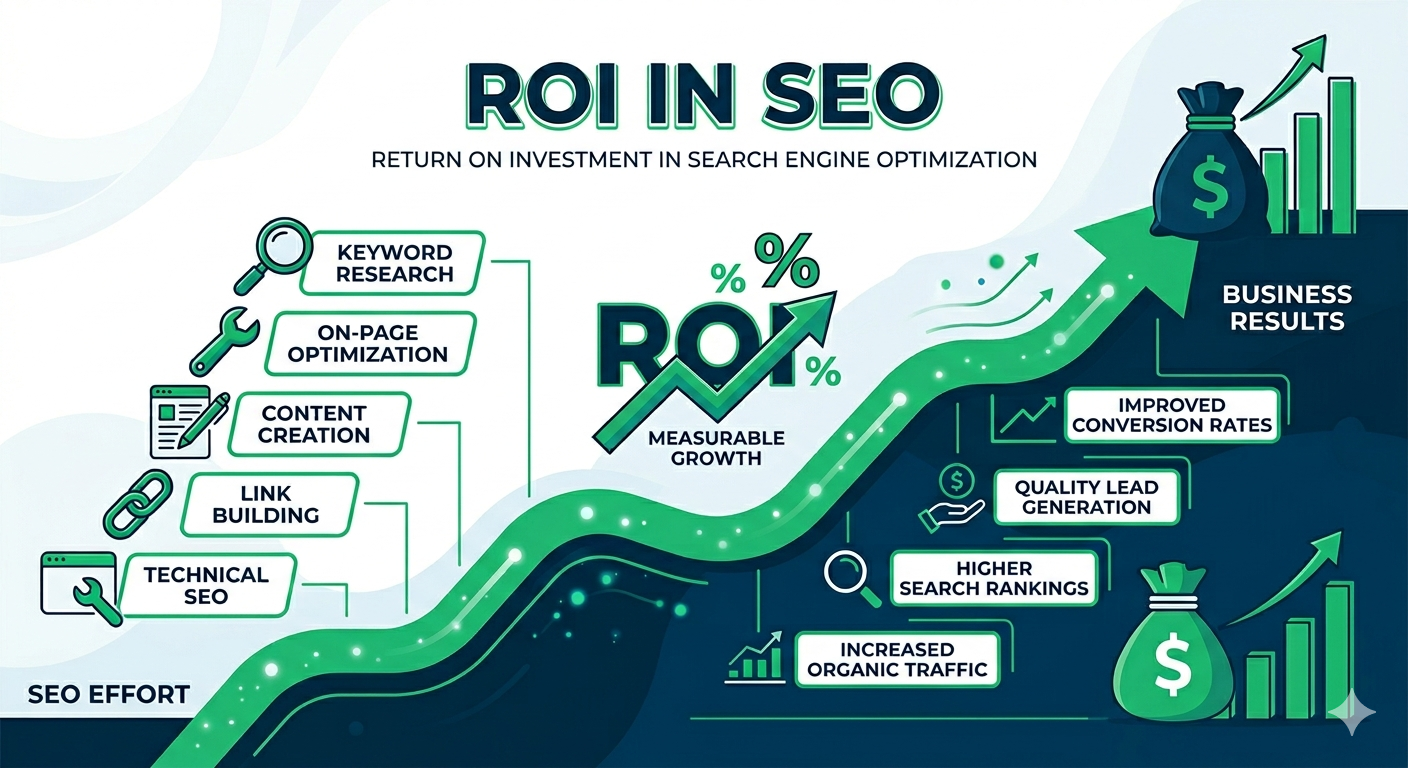
SEO continues to be a powerful medium for sustainable growth. Organic search is one of the most valuable digital channels according to industry research, which states that more than half of traffic on a webpage is achieved by organic search.
The unique aspect of SEO is that it is cumulative. When your site begins to rank, it can earn you stable traffic without having to incur the constant cost of advertising. For this reason, many businesses team up with Top SEO Companies to improve their organic presence.
The field of SEO is changing fast in the year 2026 with the advent of AI-Driven SEO. Search engines are becoming more intelligent and are more user intent-oriented, content-oriented and experience-oriented. Companies investing in SEO today are setting themselves up to prosper in the long-run.
Another important aspect is trust. The organic results are usually trusted by the users more as compared to paid ads and this enhances greater engagement and conversion in the long term. This is particularly critical to businesses that deal with informational or research based queries.
Nonetheless, there are challenges of SEO. It is time-consuming, regular, and skillful. The results can only be obtained after months, but when done, they can give a good base on which growth can be achieved.
ROI in PPC
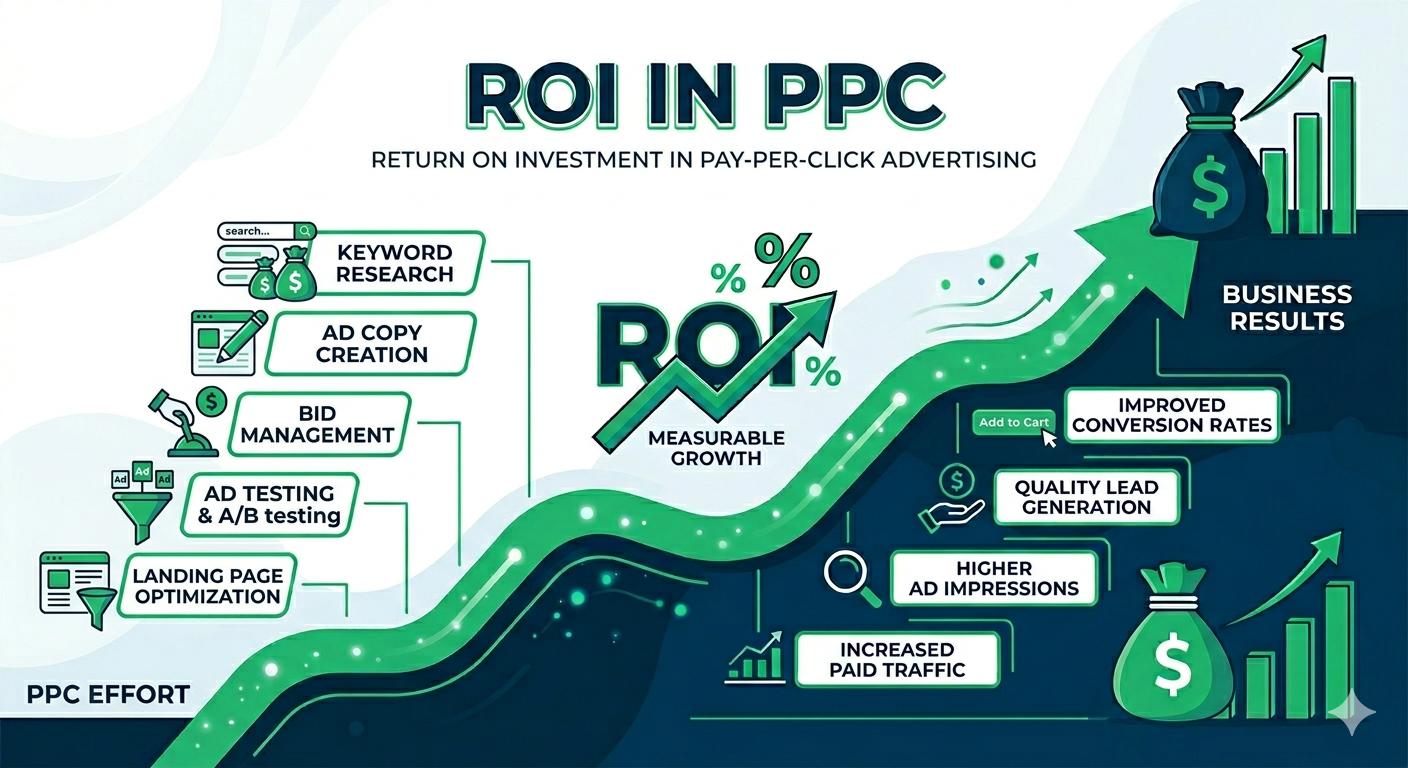
SEO is a marathon, PPC is a sprint.
PPC campaigns have the ability to begin to drive traffic and leads within hours after launch. This is because they are best suited to the businesses, which require swift outcomes like launching a product or a seasonal campaign.
Studies show that businesses make an average of $2 for every $1 spent on Google Ads, highlighting the potential ROI of well-optimized campaigns. PPC Agencies Optimize Campaigns here by refining the targeting, ad copy, and maximizing conversions.
Precision is one of the largest benefits of PPC. You have the ability to target users based on their location, demographics, behavior and the type of device. This will guarantee that you are getting the right audience and at the right time.
Moreover, PPC Assists in Generating Leads because it attracts high-intent users who are in search of products or services. This renders it an effective lead generating and sales tool.
But there are shortcomings of PPC. The expenditure can escalate swiftly, particularly in the competitive industries. And with the former, as opposed to SEO, as soon as you stop paying, your traffic goes away.
SEO vs PPC: Direct ROI Comparison
When comparing SEO and PPC, the difference lies in how they deliver value.
SEO is more cost-effective in the long run. While the initial investment may be high, the ongoing cost per lead decreases over time. PPC, on the other hand, requires continuous investment but offers faster returns.
In terms of timing, PPC wins for instant results, while SEO builds momentum gradually. For businesses looking for quick wins, PPC is the obvious choice. But for those focused on sustainability, SEO is the better option.
Lead quality also varies. SEO often attracts users in the research phase, building trust over time. PPC targets users ready to take action, leading to quicker conversions.
Scalability is another factor. PPC campaigns can be scaled instantly by increasing the budget, whereas SEO requires time and effort to expand reach.
The Hybrid Strategy: Combining SEO and PPC for Maximum ROI
The smartest businesses in 2026 aren’t choosing between SEO and PPC, they’re combining both.
A hybrid strategy allows you to leverage the strengths of each channel. PPC can drive immediate traffic while SEO builds long-term visibility. Data from PPC campaigns can also be used to refine SEO strategies, such as identifying high-performing keywords.
For example, a business can use PPC to target high-intent keywords while simultaneously creating SEO content to rank organically for those terms. Over time, this reduces dependency on paid ads while maintaining strong visibility.
This integrated approach ensures maximum ROI and a balanced marketing strategy.
Industry Trends Impacting ROI in 2026
Several trends are shaping the future of SEO and PPC.
AI is playing a major role in both areas. From automated bidding in PPC to AI-driven content optimization in SEO, technology is transforming how campaigns are managed.
Voice search and visual search are also gaining popularity, changing how users interact with search engines. Businesses need to adapt their strategies to stay relevant.
Privacy regulations and the shift towards cookie-less tracking are impacting data collection, making it essential for businesses to focus on first-party data.
At the same time, competition is increasing, and ad costs are rising. This makes it even more important to invest in strategies that deliver sustainable ROI.
Which Strategy Wins in 2026?
So, which strategy delivers better ROI in 2026—SEO or PPC?
The truth is, there’s no one-size-fits-all answer.
SEO is the clear winner for long-term value. It builds trust, reduces costs over time, and helps businesses achieve long-term growth. On the other hand, PPC excels in delivering quick results, precise targeting, and immediate lead generation.
For most businesses, the best approach is not choosing one over the other but combining both. While SEO builds a strong foundation, PPC accelerates growth and captures opportunities.
In a competitive digital world, success comes from using the right strategy at the right time. By understanding your goals, budget, and timeline, you can create a marketing plan that maximizes ROI and drives sustainable business growth.